
Switched
Ceramics possess a contradictory quality that transformed my way of understanding matter: while a fired piece can remain for centuries, clay in its pre-fired state maintains the possibility of returning once again to its origin and being reused infinitely. This condition between permanence and transformation sparked my interest in exploring the relationship between creation, detachment, and impermanence.
From my collective artistic practice in Nortejiendo, detachment has been a concept present for years as part of the creative process: learning to undo, modify, or abandon hours of work in favor of new possibilities. However, upon beginning my individual exploration within ceramics, I understood that this concept still had new dimensions to reveal. Detachment did not only imply giving up an initial idea or accepting that a piece does not fulfill its initial purpose, but also opening ourselves to the possibility that what is left behind continues to transform and acquires a new meaning.
Conmutado arises from this reflection, based on a clay bowl that ceased to be a piece destined to fulfill its initial intention to become an exercise in acceptance and transformation, which invites us to think about the symbolic exchange between artistic practice and matter.
Description
During my first approaches to ceramics, guided by the Chihuahuan artist Gabriela Híjar, I experimented with the four basic methods of clay modeling. In one of these exercises, using the coiling technique, I decided to create a bowl with small perforations that would later allow for a textile intervention.
The intention to combine both materials arose from my interest in linking ceramics with my previous background in textile practices; however, due to the close proximity of the holes, the drying process caused tension in the piece, which generated cracks and weakened its structure. Observing the result, it was evident that the bowl could hardly fulfill the original idea of being intervened with weaving.
After discussing it with my teacher, we decided to preserve the uncertainty of what would happen during firing, leaving open the possibility that the piece might endure or end up turning into something else. For several weeks, I kept the unfired piece until, during the first module of the "Caja de Herramientas" program (Proyecto Plexo, 2025), a reflection emerged that would change its fate.
In one of the modules, the concept of "Kusōzu" was addressed, a Japanese artistic tradition based on the representation of the nine stages of decay of a body as a form of contemplation on the transience of existence. These images show the gradual process of transformation of a body until its integration with the environment, inviting reflection on impermanence.
As a final exercise of the module, each participant had to choose one of their own elements to perform an action of decomposition within a natural space. Remembering the unfired bowl kept aside in the workshop, I decided to use this piece as an opportunity to practice detachment from a new perspective: instead of keeping it in hopes that it would fulfill its initial purpose, I chose to return it to the environment even knowing that there was still a possibility that it could work.
The action took place in Ojos del Chuviscar, a natural area near the city of Chihuahua that gives rise to the Chuviscar River. I placed the bowl inside a puddle I found, which caused the clay to hydrate, disintegrating completely in a matter of minutes until it joined the sediment in the water.


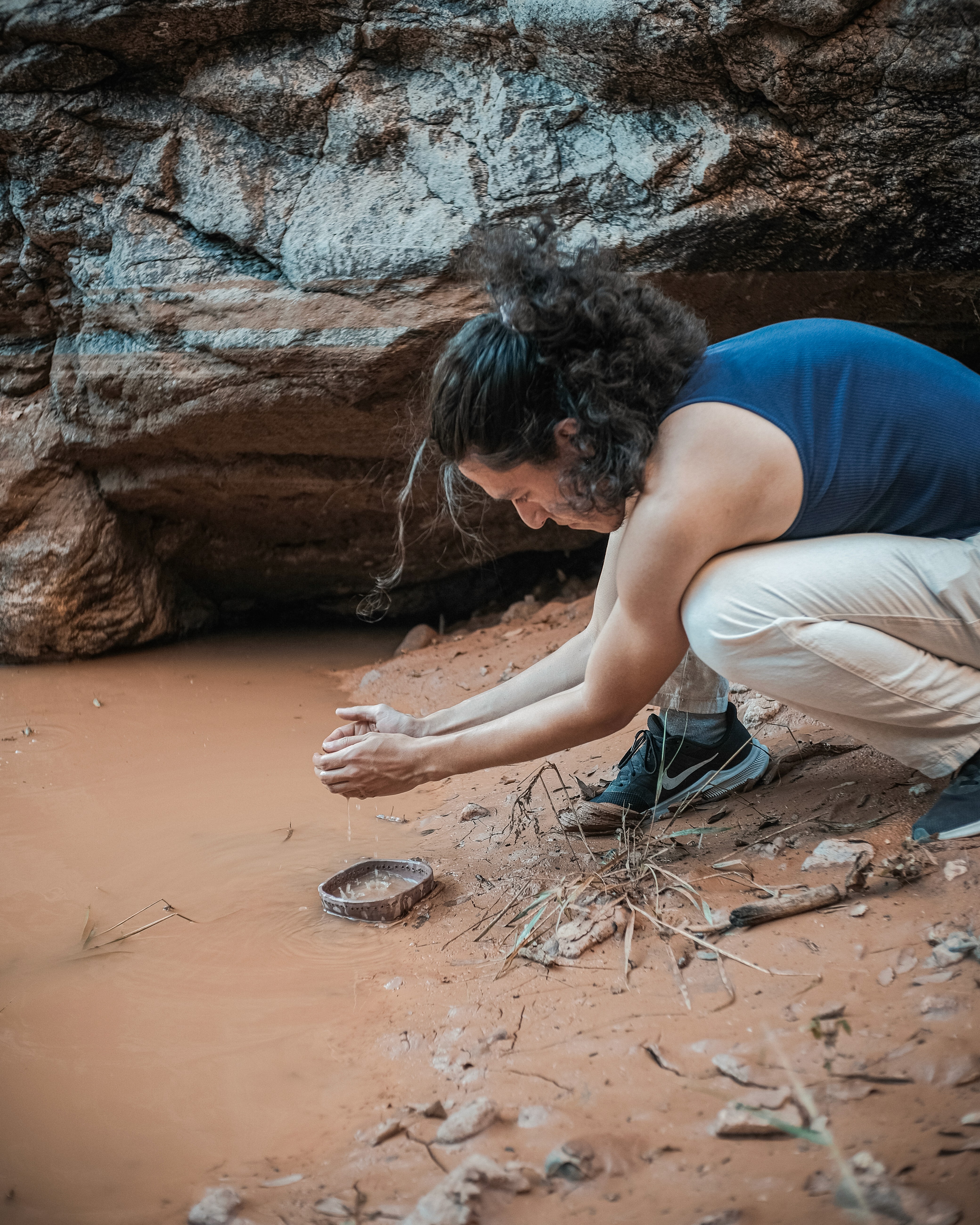


Months later, I returned to the site to collect natural clay to begin some ceramic experiments. To my surprise, I found the remains of the bowl still partially recognizable, like the bones of a decaying body that remain before fully integrating with the earth.
At the same time, I discovered an abundant presence of natural clay in that very space, which I interpreted as a symbolic response from the environment to the action taken: that which I had returned to the earth as an act of detachment reappeared as a new possibility for creation.
I decided not to recover the remains of the piece, respecting the meaning of the action and allowing the process to continue until its complete integration with the environment. “Conmutado” thus represents an exchange between matter and nature, where the apparent discarding is transformed into learning and where loss ceases to be an end to become a new form of origin.


Credits
* Photography: Oscar Solis.

